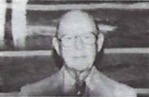
Although Elwood was born and grew up in Kansas City, Missouri, he spent his professional life in a variety of places. He taught school in Kansas City, taught at the University of Buffalo, Duke University and finally taught Botany, Bacteriology and Microbiology at Ohio Wesleyan. Upon retiring, he moved to Portland, Oregon; 4 years later he moved to Aurora, Colorado, accompanying with his daughter and her family.
Elwood's father was a professor of Natural Science in the Kansas City Teacher's College (no longer exists). He taught summer classes with a group of people who developed the area in Estes where Elwood now lives (Olympus Lodge hill). Camp Olympus was the grandchild of John Randolph Bell, who was in the teacher's college in Greeley (N. Co U). He organized a company called the Greeley Estes Park Outing Company, in which educators could buy stock. If you bought stock, you got a building site (but you did not own the land). Mr. Bell had purchased the land in the Olympus Heights area, buying it from Mr. White who was the agent of Lord Dunraven. He then built a lodge there which had one more floor than does now. After the depression, the land was resurveyed and the various members of the company actually bought their building sites. Each site was very small—about five hundredths of an acre. Elwood's two brothers and one sister own the original site; Elwood and his wife built a little further up the hill and his other sister (Maggie Jenkins-was a SRA member) built across the road from the site. Initially, the Shirling house had a well and storage tank close to Elwood's current house. "In those days, we had hot and cold running water hot in the daytime and cold at night". Elwood used to have to come up to the tank and get water to take down to the cabin. About 1966-67, the Olympus was foreclosed and parts of the property were auctioned off, including the old water system. Elwood was instrumental in leading the residents of the area to get city water which they obtained in 1973.
Elwood first came to Estes Park when he was 9 or 10 years old (1923-1924). There were no motels in the first years they came out; instead there were "tourist camps" and not very many of them. The Shirlings would find a schoolyard and pitch their tent. One of the first trips Elwood remembers was coming up the Big Thompson canyon at dusk. The road was a single lane, not even as wide as Fall River Road in places. If you came to a curve, you were supposed to honk your horn in case traffic was coming the other way. Uphill traffic had the right of way, so if you met someone, the downhill car had to back to a place where the other could pass. You knew how to keep out of the river by the headlights shining on the weeds along the side of the river. The current road up the canyon (Route 34) takes a slightly different route.
Roads into town were dirt roads. There were three stables in town. People who went on hikes would ride horses to wherever they were going. They would then turn the horses loose and the horses would trot back to their stables. The dirt roads were fertilized by the horses. For entertainment, there was the Dark Horse dance place, which all the old timers remember fondly. Near the dance hall there was a shooting gallery, like a carnival where you would try to win prizes. Also near the center of town was a booth where you would shoot an arrow into a barrel and try to get an apple.
During Elwood's caddy days (12-16 years old), the 18-hole golf course was in the same location it is now. It later became a 9-hole course with an airstrip on the rest of it. The only water came from a well; it had a single cylinder gasoline pump with a fly wheel so that it would fire. They had oiled sand for greens. Instead of a flag, they had a bow with a crossbar. The caddy would rake a smooth path from the ball to the hole with this crossbar. If you were in the fairway, you were allowed to pick up your ball and put it on top of the buffalo grass. If you were in the rough, you were supposed to play as it was. If you had an experienced caddy, he knew how to pick up the ball with his feet and move the ball to a better place; that helped the caddy get his 25-cent tip! One of the golfers was Joe Mills.
As time went on, the town began to mature. There were fewer T-shirt shops, but plenty of souvenir shops. When Safeway was proposed, there was a lot of dispute; people thought it would block the view from/ of the Stanley.
Elwood joined the SRA in 1985, after being recommended by the Pedleys. After Elwood's wife passed away, he saw the Pedley's driving out at mealtimes. He asked if he could join them when they went out and so the Pedley's sponsored him into SRA. One time after he joined, Harold Pedley was assigned to help Johnny Thompson with the PA system, so Elwood helped too. After that, Elwood helped Thompson load up the equipment. Then, Johnny noticed that Elwood had a van and he asked Elwood to take the equipment. Before long, Elwood hauled the system to and from every function. One reason Elwood enjoyed working with the audio equipment was that it gave him something to do and he missed out on the "opportunity" to serve on the breakfast committee!
Elwood still lives in the home he and his wife built with some renovations. He is still active in golf and still helps with the PA system!